Students usually know the word increase. That is not the problem.
The problem is where they put it.
A sentence can have the right vocabulary and still sound wrong because the word form is wrong. This happens all the time in IELTS Writing Task 1, especially when students describe line graphs.
Look at this mistake:
Wrong: Sales had a dramatically rise.
The meaning is clear, but the grammar is not. You have two better choices:
Right: Sales rose dramatically.
Right: There was a dramatic rise in sales.
Same idea. Different grammar. And IELTS cares about that.
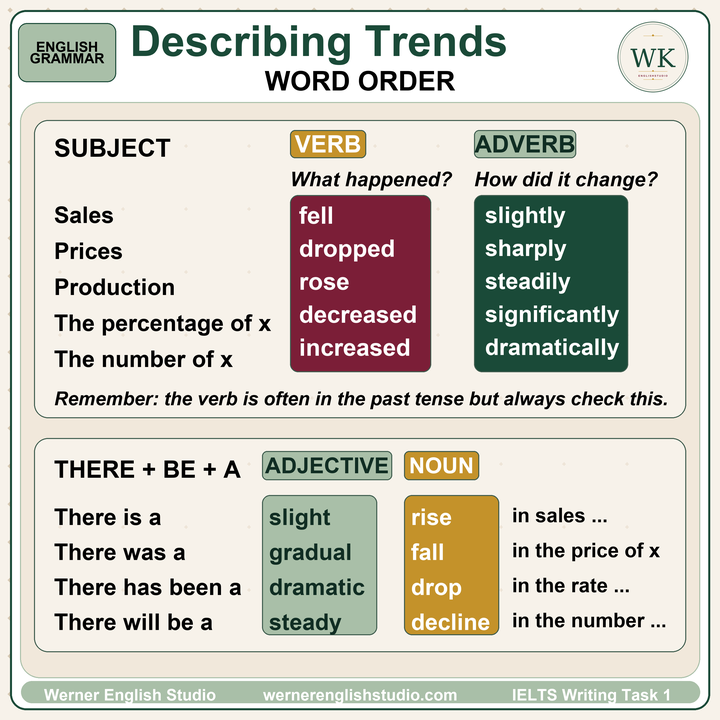
The graphic for this lesson shows two patterns you should control:
- Subject + verb + adverb
- There + be + a/an + adjective + noun
Do not mix them.
Pattern 1: Subject + Verb + Adverb
Use this pattern when the data is the subject of the sentence.
Examples:
Sales fell slightly.
Prices dropped sharply.
Production rose steadily.
The percentage of X decreased significantly.
The number of X increased dramatically.
The verb tells us what happened: fell, dropped, rose, decreased, increased.
The adverb tells us how it happened: slightly, sharply, steadily, significantly, dramatically.
This is usually the cleanest sentence in Task 1. It is short, clear, and easy for the examiner to follow.
But there is one common mistake.
Wrong: Prices dropped sharp.
Right: Prices dropped sharply.
After a verb, use an adverb.
Pattern 2: There Was A + Adjective + Noun
Now compare that with the noun structure:
There was a slight rise in sales.
There was a gradual fall in the price of X.
There has been a dramatic drop in the rate.
There will be a steady decline in the number of X.
Here, the trend word is a noun: rise, fall, drop, decline.
Because it is a noun, the describing word before it must be an adjective.
Right: a dramatic drop
Wrong: a dramatically drop
That mistake is very common because students translate from the verb pattern.
They remember:
Prices dropped dramatically.
Then they try to make a noun sentence and write:
There was a dramatically drop.
But the noun sentence needs the adjective:
There was a dramatic drop.
The Rule To Remember
Use this check:
Verb + adverb
Prices rose sharply.
Adjective + noun
There was a sharp rise in prices.
That is the whole lesson.
Do not make it more complicated than it needs to be. IELTS Task 1 does not reward long grammar if the basic word order is unstable. A simple accurate sentence is better than a fancy broken one.
Practice It Both Ways
Take one trend and write two sentences.
Example:
The price of chocolate rose sharply.
There was a sharp rise in the price of chocolate.
Now try another one:
The number of students fell slightly.
There was a slight fall in the number of students.
This is boring practice, but it works. It trains you to move between verb sentences and noun sentences without losing control.
That matters because your report should not sound like one repeated template. You need variety, but the variety must be grammatical.
Before You Submit
When you check your Task 1 answer, ask one question:
Is this word describing a verb or a noun?
If it describes a verb, use the adverb form:
increased steadily
dropped sharply
If it describes a noun, use the adjective form:
a steady increase
a sharp drop
This one check fixes a lot of trend-description mistakes.
You do not need to memorize twenty model sentences. Learn the pattern, practise both forms, and keep the grammar under control.