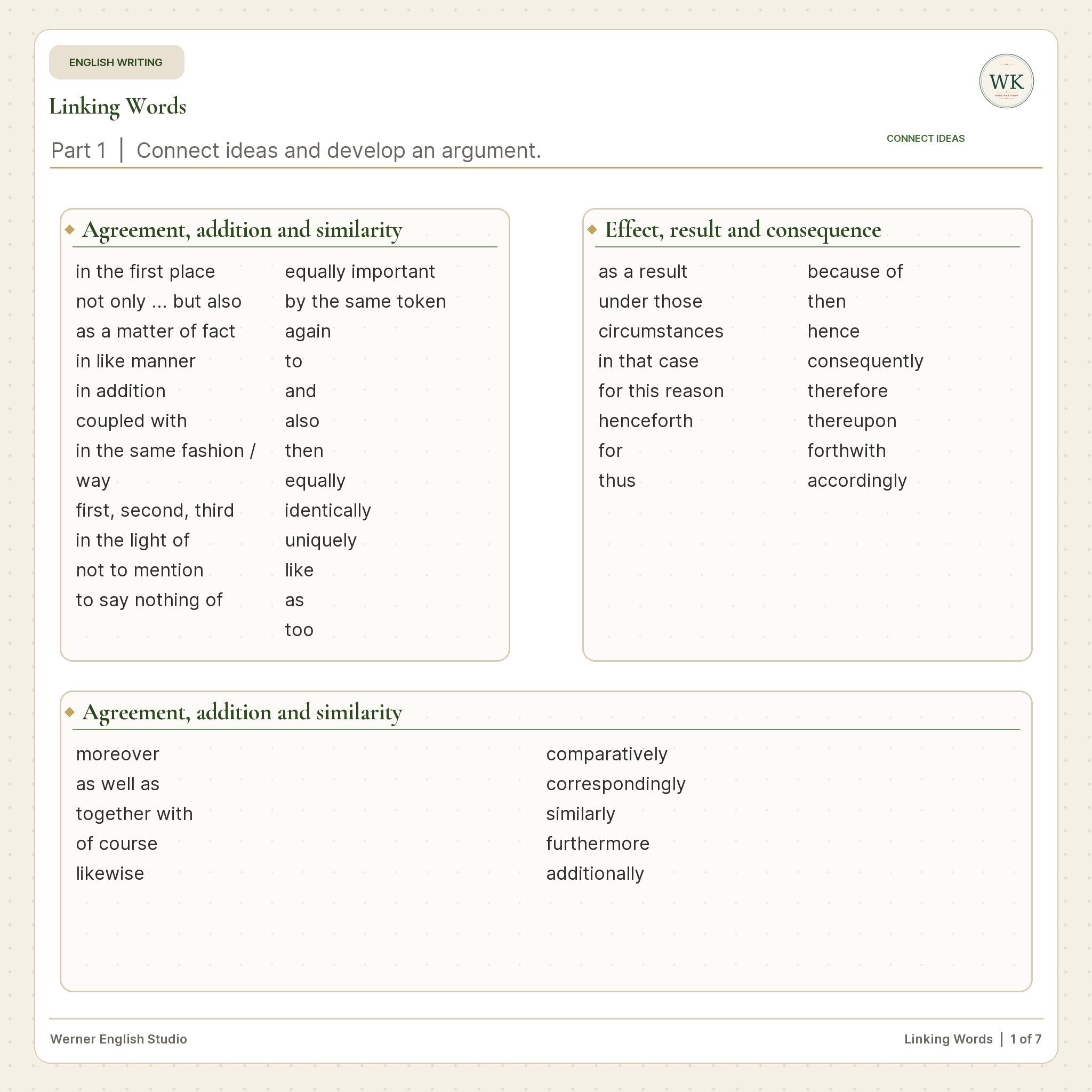
Transition words help readers follow the logical progression of an essay. When students add words like moreover or however without checking the relationship between two clauses, the sentence often becomes confusing.
The Werner English Studio reference chart groups linking words by their functional job: Addition, Opposition, Cause and Purpose, and Conclusion. Selecting a connector based on its specific category keeps your argument clear and steady.
1. Adding Information And Supporting Points
Use addition signals when you need to introduce extra evidence or expand an existing claim.
Connectors: in addition, furthermore, moreover, as well as.
Awkward: Online courses save commute time. However, they reduce travel expenses.
Natural: Online courses save commute time; furthermore, they reduce travel expenses for students.
Furthermore signals that the second point reinforces the first benefit.
2. Showing Contrast And Setting Limits
Use opposition signals when introducing a counterpoint, a concession, or an alternative view.
Connectors: however, on the other hand, whereas, despite.
Awkward: Solar panels require a high initial investment. In addition, they lower electricity bills over time.
Natural: Solar panels require a high initial investment; however, they lower electricity bills over time.
However prepares the reader for a positive contrast to the upfront cost.
3. Explaining Reasons, Conditions, And Purpose
Use cause and condition signals to show why an action happened or what outcome was intended.
Connectors: because of, owing to, in order to, provided that.
Awkward: The company updated its training program. Therefore, employees learned new software.
Natural: The company updated its training program in order to train staff on new software.
In order to directly links the administrative decision to its goal.
4. Summarizing And Closing An Argument
Use conclusion signals in final paragraphs to gather earlier points into a reasoned final judgment.
Connectors: in summary, all things considered, on balance, to conclude.
Example: All things considered, regular classroom practice remains the most reliable route to speaking fluency.
A Common Transition Mistake
Students often insert formal transition words at the start of every sentence. This creates a choppy, mechanical rhythm. Instead of adding a connector to every line, let adjacent ideas connect through natural subject-verb logic, and save linking words for moments where the argument shifts or adds weight.
What Students Should Remember
Before choosing a linking word, ask one question: What is the logical relationship between these two sentences?
- If you are adding evidence, choose an addition word.
- If you are changing direction, choose a contrast word.
- If you are explaining why, choose a cause or purpose word.
- If you are finishing, choose a summary word.
Vocabulary Builder (B2–C1 Level)
- Coherent (B2 · adjective): Clear and logically connected. "Choosing the right connector makes your paragraph coherent and straightforward to read."
- Concession (C1 · noun): Acknowledging that an opposing point has validity before presenting your main view. "Starting with a brief concession shows balanced academic judgment."
- Furthermore (B2/C1 · adverb): Introducing an additional supporting fact. "The new library offers extended hours; furthermore, it provides quiet study rooms."
- Subordinate (C1 · verb): Making one clause depend on another to show hierarchy in an argument. "Subordinating minor details keeps the main claim prominent."