Students usually know the words always, usually, and sometimes. The problem is word order: students do not always know where in a sentence these words should be placed.
If you put the adverb in the wrong place, the sentence sounds unnatural. If you choose the wrong adverb, the meaning becomes too strong or too weak. This matters in speaking because frequency words are small, but they carry a lot of meaning.
Compare these:
I always exercise.
I sometimes exercise.
I rarely exercise.
The grammar is almost the same. The meaning is completely different.
What Frequency Adverbs Show
Frequency adverbs tell us how often something happens.
Use them for habits, routines, and repeated actions.
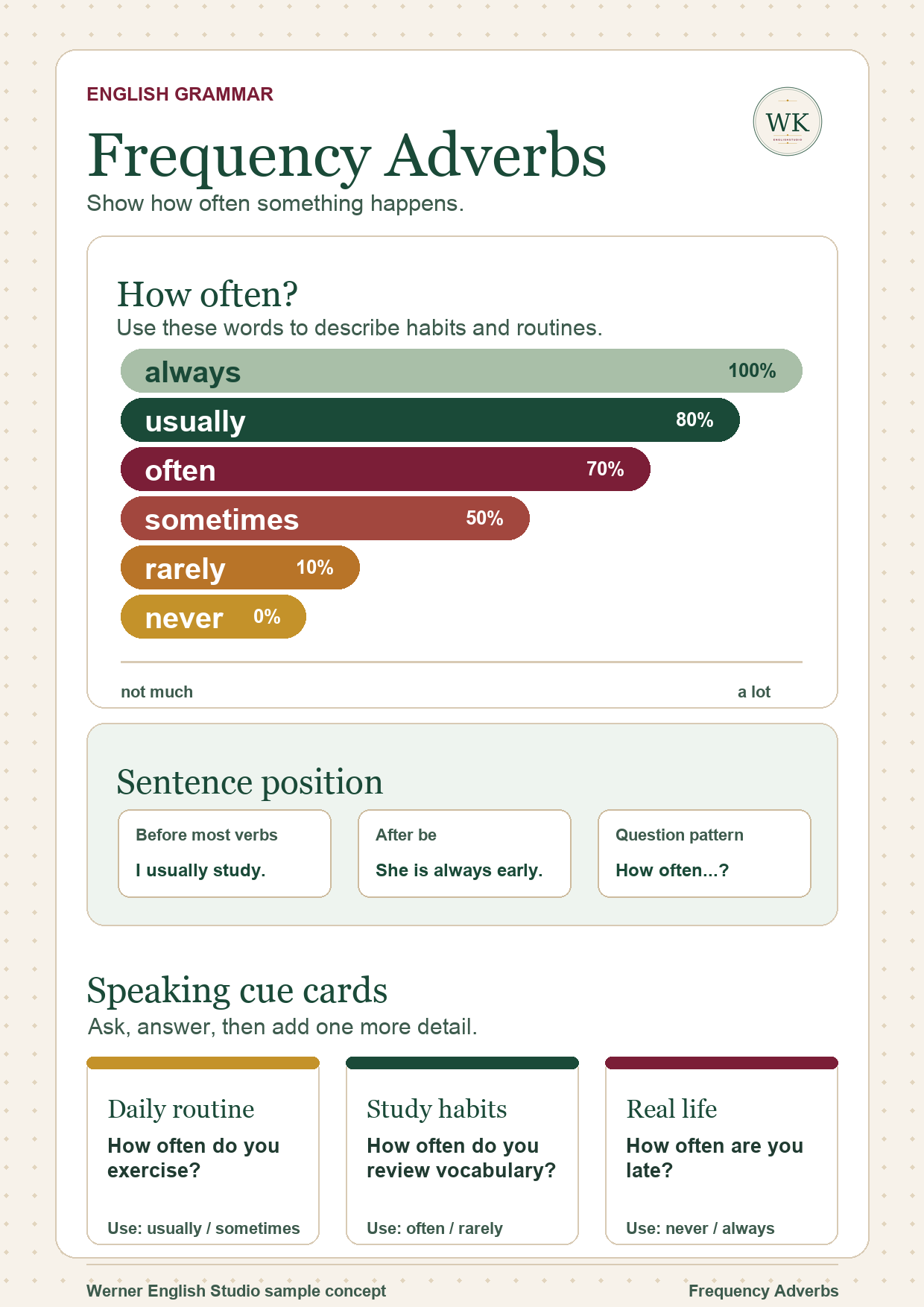
Here is the basic scale:
always = 100%
usually = about 80%
often = about 70%
sometimes = about 50%
rarely = about 10%
never = 0%
Do not treat these words as exact mathematics. They are not test percentages. They are a way to show general meaning.
If you say, I always study at night, you are saying this is your normal pattern.
If you say, I sometimes study at night, you are saying it happens, but not regularly.
That difference matters.
Do Not Overuse Always
Many students use always when they only mean usually.
Wrong meaning: I always eat breakfast at 7.
Better: I usually eat breakfast at 7.
Why?
Because always is very strong. It means there are almost no exceptions. If you eat breakfast at 7 most days, but not on weekends, usually is more accurate.
This is the part students often miss. Good English is not only about correct grammar. It is also about choosing the word that matches real life.
Sentence Position
For most verbs, put the frequency adverb before the main verb.
Examples:
I usually study.
She often reviews vocabulary.
They sometimes exercise after work.
He rarely watches TV.
I never drink coffee at night.
The pattern is simple:
Subject + frequency adverb + main verb
Do not write:
Wrong: I study usually.
Right: I usually study.
Some adverbs can move in natural English, but this basic position is the safest one for learners.
After Be
With the verb be, the adverb usually comes after the verb.
Examples:
She is always early.
I am usually busy in the morning.
They are often late for meetings.
He is rarely absent.
The classroom is never quiet before the lesson starts.
The pattern is:
Subject + be + frequency adverb + adjective/noun phrase
This is why these two sentences use different word order:
I usually study.
I am usually busy.
In the first sentence, study is the main verb. In the second sentence, am is the verb be.
Small difference. Big grammar effect.
Asking Questions
To ask about frequency, use:
How often...?
Examples:
How often do you exercise?
How often do you review vocabulary?
How often are you late?
How often do you eat out?
How often do you practise speaking English?
This question is useful because it gives students a natural way to practise habits and routines.
But the answer should not stop after one word.
Weak answer: Usually.
Better: I usually exercise three times a week.
Better: I sometimes exercise after work, but I am not very consistent.
That second answer sounds more natural because it gives one extra detail.
Use Frequency Adverbs In Speaking
For speaking practice, use this simple pattern:
Answer the question, then add one more detail.
Question: How often do you exercise?
Answer: I usually exercise three times a week. I go to the gym after work if I have enough time.
Question: How often do you review vocabulary?
Answer: I often review vocabulary before class. I write the new words in a notebook and test myself later.
Question: How often are you late?
Answer: I am rarely late. I prefer to arrive early because I do not like rushing.
That is enough.
You do not need a long answer. You need a clear answer with one useful detail.
Be Honest With The Adverb
Choose the adverb that matches your real meaning.
If something happens every day, use always or usually.
I usually drink coffee in the morning.
If something happens from time to time, use sometimes.
I sometimes study English before bed.
If something almost never happens, use rarely.
I rarely watch movies during the week.
If something does not happen at all, use never.
I never skip breakfast.
This makes your English sound more precise. It also makes your speaking answers easier to believe.
Practice
Answer these questions with a frequency adverb and one extra detail.
- How often do you exercise?
- How often do you review vocabulary?
- How often are you late?
- How often do you speak English outside class?
- How often do you watch videos in English?
Example:
I usually review vocabulary at night. I write three example sentences so I can remember how to use the words.
That is the kind of answer you want.
Not long. Not memorised. Just clear.
The Rule To Remember
Use frequency adverbs to describe habits and routines.
Put them:
Before most verbs
I usually study.
After be
She is always early.
And when someone asks How often...?, do not give only one word. Answer the question, then add one more detail.
That is how a small grammar point becomes useful speaking practice.